




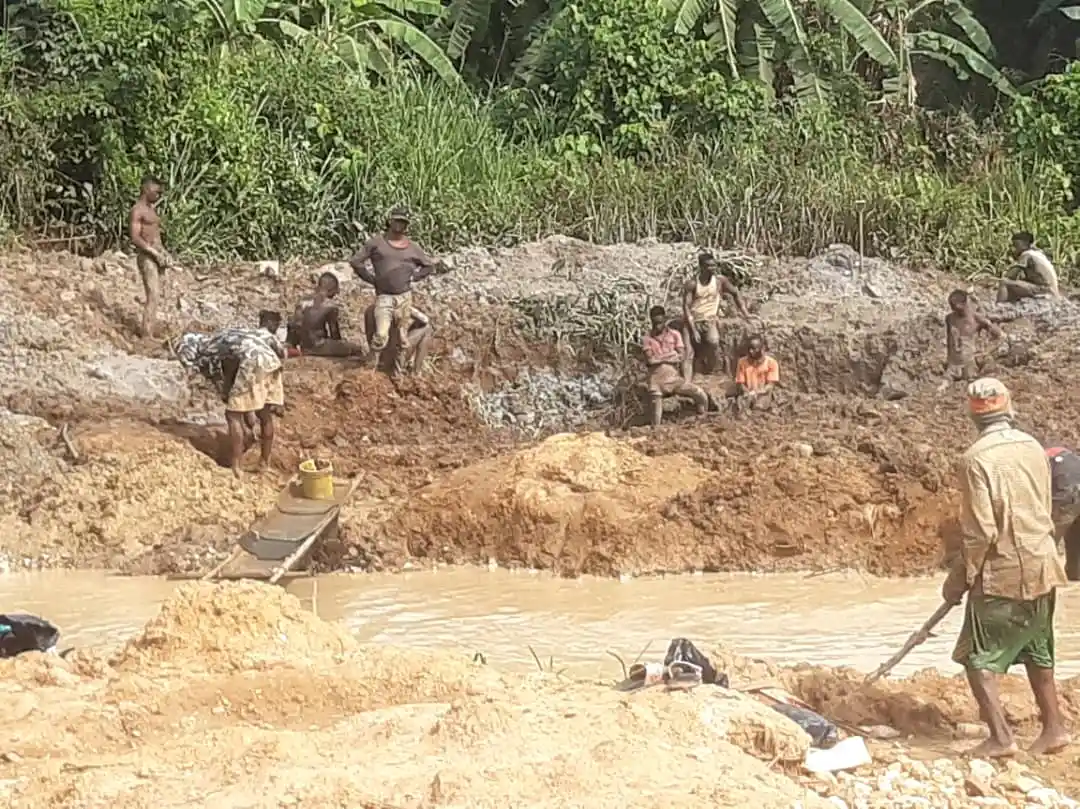
The last time I travelled along the Ilesa-Ibadan Expressway, I was left dumbfounded by the alarming scale of unregulated mining taking place right beside the highway. The operations were so reckless that it was obvious they were being carried out with a sense of impunity.
Unfortunately, I was unable to take photographs at the time. Thankfully, Senator Babafemi Ojudu captured images that vividly expose the environmental destruction being committed in the name of mining. Those photographs should serve as evidence to draw national and international attention to this unfolding disaster.
It is deeply disturbing that the Ijesa community, the Osun State Government, and the Federal Government through the Ministry of Solid Minerals Development have all failed to halt this environmental crime. By every standard, the mining activities along the Ilesa end of the expressway reflect the country’s weak regulatory enforcement and the political class indifference to environmental protection and public safety.
I deliberately hold both state and federal authorities responsible because it is inconceivable that such large-scale operations could continue for years without their knowledge.
Related Posts:
This problem is not limited to the Ilesa-Ibadan Expressway. In communities such as Iperindo, some licensed mining companies have reportedly extended their operations beyond the boundaries allocated to them by the Mining Cadastre Office, violating the law. Their activities are equally aggressive and environmentally destructive.
A closer examination of mining operations across Nigeria reveals what appears to be a network of complicity involving local communities, security agencies, regulators, and political actors. Such collaboration has allowed illegal and irresponsible mining to thrive with little consequence.
Few would have imagined that mining could one day be carried out openly beside a major federal highway even despite the fact that Section 3(1c) of the Nigerian Minerals and Mining Act, 2007 forbidden such. It raises an important question: what is the value of investing billions of naira in road construction if mining activities are allowed to undermine the very infrastructure being built? Even more troubling is the fact that these activities have reportedly continued for over six years without any meaningful government intervention to halt it.
In a country where the rule of law is respected, those responsible for these illegal operations, including their sponsors, would have been arrested and prosecuted. Unfortunately, the persistence of such activities suggests that influential individuals across different sectors benefit from the proceeds of illegal mining. The situation is a direct violation of Section 61(1)(a) and (b) of the Nigerian Minerals and Mining Act, 2007, which requires mining to be conducted in an environmentally responsible manner.
Anyone travelling along the expressway cannot ignore the extensive environmental degradation. The destruction of the landscape is not only an eyesore but also a source of concern for anyone who values environmental sustainability and public safety. The activities also appear inconsistent with the provisions of Section 70(1)(c) and (d) of the Nigerian Minerals and Mining Act, 2007, which establishes obligations for responsible mining practices.
Although Nigeria has a comprehensive legal framework governing mining, enforcement remains weak. The Mining Cadastre Office and other regulatory institutions must bear responsibility for allowing widespread non-compliance. Beyond environmental degradation, illegal mining poses serious security risks.
Across parts of Northern Nigeria, violent conflicts over control of mining sites have resulted in significant loss of lives. Security agencies have also linked proceeds from illegal mining to the financing of criminal and terrorist networks. These developments make government inaction even more difficult to justify.
The authorities must urgently recognise that illegal mining is no longer merely an environmental issue; it has become a national security and economic challenge. Effective regulation, stricter monitoring, and the prosecution of offenders are essential if Nigeria is to benefit from its mineral resources without sacrificing public safety and environmental sustainability.
It is particularly disappointing that despite repeated claims that Nigeria possesses mineral resources worth hundreds of billions of dollars, the sector contributes far below its potential because illegal operators dominate much of the industry.
Reports have consistently estimated that billions of dollars’ worth of gold leave the country annually through illegal mining networks allegedly protected by powerful interests. If these reports are accurate, the nation is losing enormous revenue while simultaneously exposing communities to environmental destruction and insecurity.
The Ministry of Solid Minerals Development must move beyond public statements and demonstrate stronger regulatory leadership. The continued dominance of illegal miners reflects systemic failures in governance and enforcement. Nigeria cannot continue to tolerate a situation where environmental laws are openly violated, critical infrastructure is endangered, and criminal networks profit from the country’s mineral wealth.
The time for rhetoric has passed. Governments at all levels, regulatory agencies, security institutions, host communities, and licensed operators must work together to restore order in the mining sector.
Illegal mining must no longer be treated as a routine occurrence but as a serious threat to Nigeria’s environment, economy, infrastructure, and national security. If decisive action is not taken now, the long-term consequences will be far more costly than the profits currently being made by those benefiting from this lawlessness.
Kazeem Olalekan Israel writes from Ibadan, Nigeria.
Source: Development Reporting